Monday, August 31, 2020

Jim Rogers Gives the Best Investing Advice You’ll Hear, Talks the Next Big Market Crash


Jim Rogers, chairman of Rogers Holdings and co-founder of the legendary Quantum Fund, said that the next financial crash could be even worse than what we saw this year. 

Rogers draws on his decades-long investing experience, from his early days on Wall St. to his successes with the Quantum Fund, to give candid advice to any investor looking to win in the long haul.

- Source, Kitco News

Sunday, August 16, 2020

Jim Rogers: People Have No Idea How Bad the Coming Crisis is Going to Be


Jim Rogers is one of the world's largest investors who like to talk about cryptocurrencies, bitcoin, real estate, and ways to make money. In this motivational video, Jim Rogers expresses his opinion on the world crisis, the collapse of the market, and the suffering of the world economy.

Wednesday, August 12, 2020

Jim Rogers on How Gold, Silver and the US Dollar Are Going to Fare Moving Forward


Jim Rogers, renowned investor and financial commentator, discusses current market themes amid the COVID-19 pandemic. 

Where is the US Dollar, gold, and silver headed given the expansive monetary policies aimed at combating virus-induced economic fallout? 

Will the Euro move beyond its current problems in relation to the conflict between the ECB and Germany's Constitutional Court? And could Bitcoin gain some profile on the back of the Euro's problems? 

Join us on this episode of Trading Global Markets Decoded to find out.

- Source, Daily FX

Friday, August 7, 2020

Jim Rogers: Bitcoin Needs to Remain Speculative

Since bitcoin’s initial inception in 2008, the currency has been pushed as a valid currency designed for purchasing goods and services. The asset was built to replace things like fiat and credit cards to give financial power and independence back to the people who would use it and remove themselves from the hands of the big banks that control the global financial system.

However, according to Rogers, if this ever did happen, bitcoin would be in serious trouble, as governments would work extra hard to eliminate it. He states:

"If the cryptocurrency succeeds as real money, rather than the subject of gambling as it is today, the government will make the cryptocurrency illegal and eliminate it."

One of the big problems that stems from bitcoin is that it seeks to make the financial world decentralized. This means no more banks, no more standard financial institutions; finance as we know it would completely disappear if bitcoin ever became completely mainstream. While this presents many benefits for the public, those running the banks see the currency as an enemy of their livelihoods. With bitcoin moving further up the financial ladder, these people stand to be out of job.

Right now, the asset is working primarily as a speculative asset. Those who choose to invest in it have an opportunity to see their wealth hedged against economic strife. In addition, they are adding to their portfolios and looking to potentially grow their wealth over time with the addition of a new asset.

Many companies aren’t allowing bitcoin to be used for purchasing goods and services given that it’s still very vulnerable to volatility and price swings, which scares businesses because they could lose money.

This could be something that’s working in bitcoin’s favor. The fact that many institutions still don’t view it as real money could be what ultimately keeps the coin in play. Over time, as its legitimacy is established, perhaps there will be greater use cases for the world’s number one cryptocurrency by market cap, but until then, Rogers feels bitcoin will be much safer as a low-key investment tool.

BTC as Real Money Is Dangerous

He states:

"The government likes electronic money because with electronic money, you can track when and where who spent what amount. Governments will have more control over people through electronic money. The government wants to know everything. Controllable electronic money will survive, and virtual currencies beyond the influence of the government will be erased… The government has something that those who work with virtual currencies don’t. It’s a gun."

Sunday, August 2, 2020

Jim Rogers on US Economy, Gold, USD Amidst Pandemic

Talk begins on the US economy – and Jim’s outlook remains as bleak as at the time of the previous DailyFX Jim Rogers podcast in August 2019. “I told you last time – the next time the world has a problem it’s going to be the worst in my lifetime.

“It is the worst in my lifetime and the reason I said it was because there was so much debt [that had] built up in the world. In 2008 we had a big problem because of too much debt; since then the debt everywhere has skyrocketed, even in China.”

Jim points to nearly every government in the world having started printing and spending staggering amounts of money. “America was already the largest debtor nation in the world, and along came [coronavirus] and America has added trillions and printed trillions more. This is going to be a serious burden for the world economy.”

As Jim sees it, the ten-year bull run in US stocks also made a market slump overdue in addition to an economic slump, and coronavirus was just an excuse. “There would’ve been some reason. Some places were already slowing down, and along came the bubble and now we have the excuse. We always have an excuse and here it is.”

Gold, Silver, USD and Safe Havens: How Safe?

So, with this outlook, what does Jim have to say about the viability of gold, USD, and other assets traditionally viewed as safe havens? “I stopped buying gold and silver in 2010 and I started buying again last summer. I bought more recently and I will probably continue to buy both gold and silver; more silver than gold now because silver is down much more.”

On USD: “It’s not a safe haven, but [the important thing is] people think it is. I still own a lot of US Dollars and I haven’t sold any. It’s going to get overpriced and it could conceivably turn into a bubble, depending on how bad things get in the world.”

USD being Jim’s currency of choice is explained in part by the unattractiveness, as he sees it, of the alternatives. “Right now with the Euro, many people are skeptical. British Pound? Please. I love the UK, but that’s not even a semi-sound currency any more. The Swiss Franc is being so debased, and as for the Japanese Yen? Japan has staggering debts, with a population declining for ten years.

“[So] which currency? That’s part of the problem.”

- Source, Daily FX, read more here

Tuesday, July 28, 2020

Governments Will Kill Crypto, Warns Jim Rogers

Bitcoin has made its fair share of enemies since it was created a little over 10 years ago, writes Forbes journalist Billy Bambrough.

The bitcoin price, soaring to around $20,000 per bitcoin in late 2017, thrust cryptocurrencies into the global limelight, prompting governments to clamp down on their use and companies such as Facebook to create their own.

Now, legendary investor Jim Rogers has warned bitcoin and similar “virtual currencies beyond the influence of the government” will not be allowed to survive – and said the bitcoin price is headed to zero.

“If the cryptocurrency succeeds as real money, rather than the subject of gambling as it is today, the government will make the cryptocurrency illegal and eliminate it,” Rogers told Japan’s Aera dot in comments translated by Google.

Rogers is perhaps best-known for co-founding the Quantum Fund with fellow legend George Soros and has gone on to establish himself as a television and media personality.

Bitcoin, still mostly used as an instrument of speculation, has attracted attention in recent months as the coronavirus pandemic has spread and governments have taken extreme action to support their economies.

The US has allocated almost $3 trillion for coronavirus-related economic aid and the Federal Reserve has pumped trillions of dollars into the US economy.

Renowned investors including Paul Tudor Jones, Dan Tapiero and Raoul Pal have identified bitcoin as a potential hedge against the inflation unprecedented central bank stimulus measures could bring, though bitcoin is still far from being used as “real money.” Some 11 million bitcoin, roughly 60% of the current minted supply, has sat dormant for a whole year, according to a recent research report published by Digital Asset Data—suggesting investors are “buying to hold.”

However, governments around the world, spurred on by China’s efforts to digitalize its yuan and Facebook’s plans for a bitcoin-inspired digital currency, have accelerated their efforts to take money and spending online. “The government likes electronic money,” Rogers said. “Because with electronic money, you can track when, where, who spent what amount. Governments will have more control over people through electronic money.”

“The government wants to know everything. Controllable electronic money will survive, and virtual currencies beyond the influence of the government will be erased.”

Many in the bitcoin community see cryptocurrencies as a way of resisting government overreach and some fear a proposed digital US dollar could hand more power to the state. Rogers’ comments could throw fuel on those fears. “The government has something that those who work with virtual currencies don’t have,” Rogers said. “It’s a gun.”

The bitcoin price, still highly volatile and prone to wild swings, is increasingly being watched by Wall Street as they launch bitcoin and cryptocurrency services and take on clients in the space.

- Source, Asia Times

Friday, July 24, 2020

A Market Forecast From Legendary Investor Jim Rogers

It may have already started,” renowned investor Jim Rogers said, while contemplating an impending market downturn. “It starts when people aren’t looking and it snowballs and builds up, and then, after a year or two, it's on the evening news.”

Although it wasn’t known at the time these predictions, spoken from his home in Singapore in January, would prove to be prophetic. The markets had been enjoying a record-breaking bull run for eleven years, but by March there was a sea of red across the screens of investors and traders.

The coronavirus pandemic sent markets in the US, Europe and Asia spiralling at speeds not seen since 2008.

But a shock like this isn’t anything new to Rogers. The stock market crash of 1987 happened on his birthday, after all.

Luckily for him, he had predicted a collapse was imminent, taking out short positions at the time. However, there was no way for him to know it would be so severe. It was “the best birthday” he ever had.

Bearing down

For the past few years, Rogers has been saying that the next time such a bear market occurs, the levels of debt are going to make for a very, very bad situation.

“In 2008, we had problems in the economy and in the markets because of too much debt. Since then, debt has skyrocketed all over the world,” he says. “What surprises me is that people don’t understand that, but to me, it’s very, very simple.”

At the time Opto went to press, many were warning of a global recession. Indeed, in an effort to temper a global economic collapse, central banks and governments had been spending and printing copious amounts of money.

While the potential impact of this turn of events may be alarming to some, Rogers remains calm. He is, after all, an expert at navigating market conditions like these. The key, he says, is not to listen to other people.

“In the 1930s, which is the most famous [economic downturn] in the past 100 years or so, a lot of people came out of that rich and built huge fortunes. But they were people who knew what they were doing and didn’t do other things, they just stayed with what they knew and became very successful,” Rogers says.

“What you really need to do when this bear market comes, is stay with what you know.”

- Source, CMC Markets, read more here

Monday, July 6, 2020

Jim Rogers Discusses Bitcoin as Money and Why Governments Will Stop Crypto

Famous investor Jim Rogers shared his prediction about the future bitcoin and cryptocurrency in an interview with Asahi Shimbun Singapore branch manager Koji Nishimura, published on Friday. Rogers cofounded the Quantum Fund in 1973 with billionaire investor George Soros, which was considered one of the most successful hedge funds in its heyday. They earned a 4,200% return over 10 years through 1980 compared to 47% for the S&P 500.

Rogers believes that if cryptocurrency succeeds in being used as money, instead of primarily for speculation, governments will intervene, making it illegal in order to stop its use. For this reason, “I believe that the [value of] virtual currencies represented by bitcoin will decline and eventually become zero,” he told the publication. “It is hard for us to move money without the control of the government,” Rogers said, elaborating:

"The government wants to know everything. Controllable electronic money will survive, and virtual currencies beyond the influence of the government will be eliminated."

Rogers explained that cryptocurrency markets are volatile, particularly during the global economic crisis. “Even though cryptocurrencies did not even exist a few years ago, in the blink of an eye, they become 100 and 1,000 times more valuable … This is a clear bubble and I don’t know the right price,” he opined, emphasizing that cryptocurrency is not an investment but gambling.

He proceeded to talk about electronic money. “Governments like electronic money because with electronic money, you can keep track of when, where, who spent and how much. Governments will have more control over people through electronic money,” the investing guru described. “Electronic money has a low issuing cost. Cash must be printed, carried and counted. It is expensive for the government.”

However, cryptocurrencies beyond the control of governments will not be accepted as money, Rogers believes, adding that those who work on cryptocurrencies think they are “smarter than the government.” However, “the government has something that those who work with virtual currencies don’t have. It’s a gun.” For this reason, he said, “I believe that virtual currency will disappear eventually.”

He believes that governments will never let bitcoin be used as money. “Only 100 years ago, we could use whatever we liked as money. You could use coins, gold, silver, or shells. Banks could also print the bills themselves. That was legal,” he was quoted as saying. However, in the mid-1930s, the Bank of England declared that using any type of money other than the money it issued was illegal, Rogers pointed out. As a result, “no one used money other than that issued by the Bank of England,” he described, predicting that the same will happen to cryptocurrency.

While admitting that a society where governments “know too much about our actions” is “unfavorable,” he believes that cryptocurrency “beyond the control of the government will not be widely distributed as money.”

While Rogers is not bullish on cryptocurrency, many institutional investors are increasingly interested in investing in this asset class. Fidelity Digital Assets recently conducted a survey of about 800 institutional investors in Europe and the U.S. and found that 80% of them find cryptocurrency appealing, while 60% feel cryptocurrencies have a place in their portfolios. Grayscale Investments also sees increasing demand for crypto investments.

Well-known hedge fund managers such as Paul Tudor Jones have been growing their bitcoin holdings. Jones said he has about 2% of his assets in bitcoin. Other billionaire investors who are bullish on bitcoin include Virgin Galactic chairman Chamath Palihapitiya and Galaxy Digital CEO Mike Novogratz.

- Source, Bitcoin News

Wednesday, July 1, 2020

There Will Soon be a Blow Up in US and Possibly Japanese Markets

What is happening to the world? Everybody is simply trying to use the word liquidity. When I ask experts why are markets going up when the world is looking bad, the simple answer is it is liquidity, it is Fed, it is money.

The main thing that is going on in the world is that central banks all over the world are printing huge amounts of money and governments are borrowing and spending huge amounts of money.Every day the Bank of Japan goes in there and starts printing money as fast as it can and is buying stocks, buying ETFs, buying bonds. 

About somewhat the same is happening all over the world. In the US, they are not buying stocks. We do not think yet, but they are buying everything else. This is insane. But it is great for investors, it is great for stockbrokers, it is great for ETNow. Is it good for the world? No.

So if global central bankers are likely to print more money and if interest rates are likely to remain low, then what could be the end game for equities and for this so-called summer madness which we have seen in just about every asset class?

First you must remember that in America, there is an election in Nov. And in Washington, they are doing everything they can to get re-elected. 

That is what they do. They do not care about us. They do not care about our children. They care about getting elected. So until November anyway, this is all going to continue in the US. But other places will probably follow too. The end game?

Friday, June 26, 2020

Legendary Investor Jim Rogers Warns Governments Will Have To "Eliminate" Bitcoin

Bitcoin has made its fair share of enemies since it was created a little over ten years ago.

The bitcoin price, soaring to around $20,000 per bitcoin in late 2017, thrust cryptocurrencies into the global limelight, prompting governments to clamp down on their use and companies such as Facebook to create their own.

Now, legendary investor Jim Rogers has warned bitcoin and similar "virtual currencies beyond the influence of the government" will not be allowed to survive—and said the bitcoin price is headed to zero.

"If the cryptocurrency succeeds as real money, rather than the subject of gambling as it is today, the government will make the cryptocurrency illegal and eliminate it," Rogers told Japan's Aera dot in comments translated by Google.

Rogers is perhaps best-known for co-founding the Quantum Fund, with fellow legend George Soros and has gone on to establish himself as a television and media personality.

Bitcoin, still mostly used as an instrument of speculation, has attracted attention in recent months as the coronavirus pandemic has spread and governments have taken extreme action to support their economies.

The U.S. has allocated almost $3 trillion for coronavirus-related economic aid and the Federal Reserve has pumped trillions of dollars into the U.S. economy.

Renowned investors including Paul Tudor Jones, Dan Tapiero and Raoul Pal have named bitcoin as a potential hedge against the inflation unprecedented central bank stimulus measures could bring, though bitcoin is still far from being used as "real money." Some 11 million bitcoin, roughly 60% of the current minted supply, has sat dormant for a whole year, according to a recent research report published by Digital Asset Data—suggesting investors are "buying to hold."

However, governments around the world, spurred on by China's efforts to digitalize its yuan and Facebook's plans for a bitcoin-inspired digital currency, have accelerated their efforts to take money and spending online. "The government likes electronic money," Rogers said. "Because with electronic money, you can track when, where, who spent what amount. Governments will have more control over people through electronic money."

"The government wants to know everything. Controllable electronic money will survive, and virtual currencies beyond the influence of the government will be erased."

Many in the bitcoin community see cryptocurrencies as a way of resisting government overreach and some fear a proposed digital U.S. dollar could hand more power to the state. Rogers' comments could throw fuel on those fears. "The government has something that those who work with virtual currencies don't have," Rogers said. "It's a gun."

The bitcoin price, still highly volatile and prone to wild swings, is increasingly being watched by Wall Street as they launch bitcoin and cryptocurrency services and take on clients in the space.

- Source, Forbes

Friday, June 12, 2020

One For The Ages

I do a good deal of reading every day and I share the best of what I find on Twitter. The purpose of this reading is not so much to find out what's really going on as it is to try to understand how people feel about what is going on. What are the trends and narratives that are important to market participants and where are they in their life cycle.

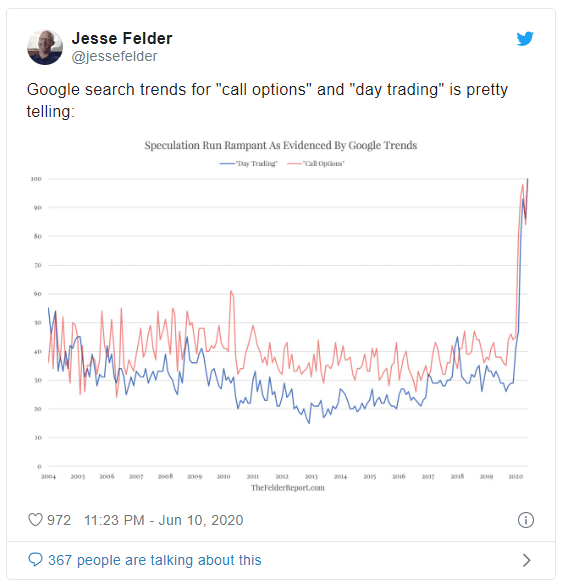
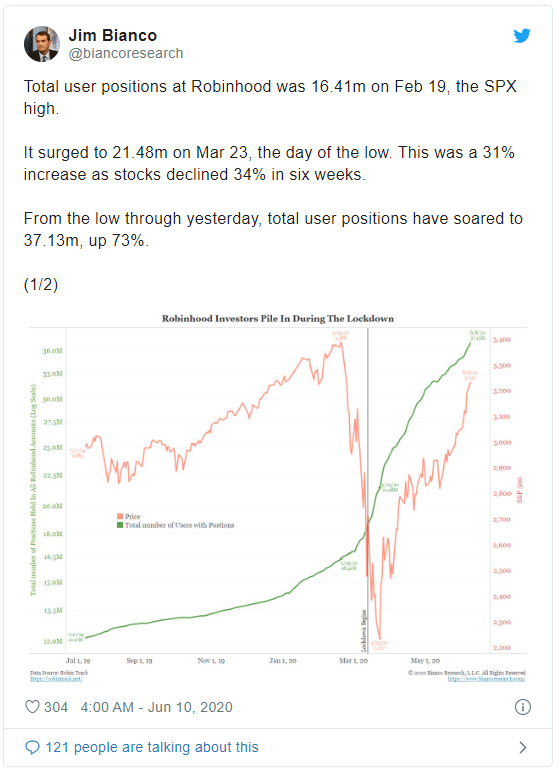
One trend I've been following for a while now is the growing participation in the financial markets on the part of young individuals. Since most brokers went commission-free, following in Robinhood's footsteps, the interest in trading has gone through the roof. This week feels like the narrative is reaching a crescendo.


So I thought it might be important to immortalize some of the stories in my recent Twitter feed in a blog post here. During the dotcom mania, my friend Bill Fleckenstein tracked the bubble in what he called, "The Mania Chronicles." Consider this my very limited version of the same.


The stock market has set many records this year. After putting in the fastest 10% decline from a new high, it then put in the fastest 20% and 30% declines. Since then, however, it's now put in the fastest recovery from a crash in history.


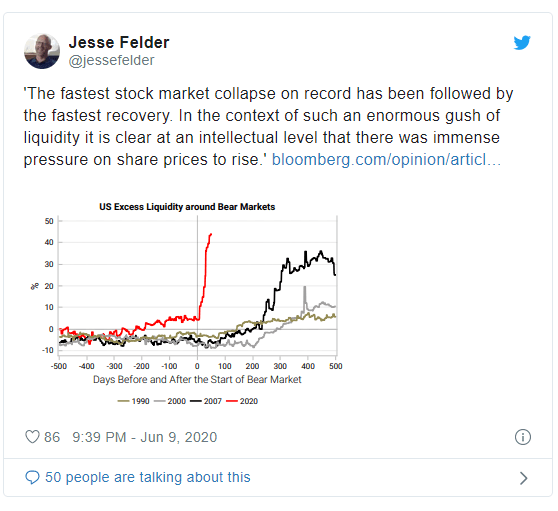
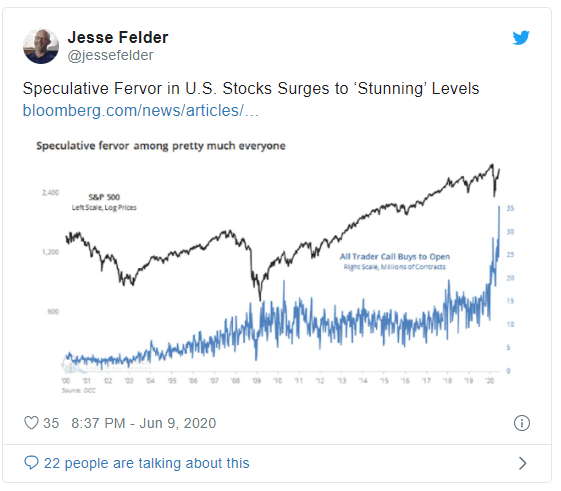
An unprecedented boom in money printing for the explicit purpose of supporting asset prices is certainly part of the reason for the recovery but it is also important to note what that money printing has inspired: an unprecedented boom in financial market speculation by retail traders.


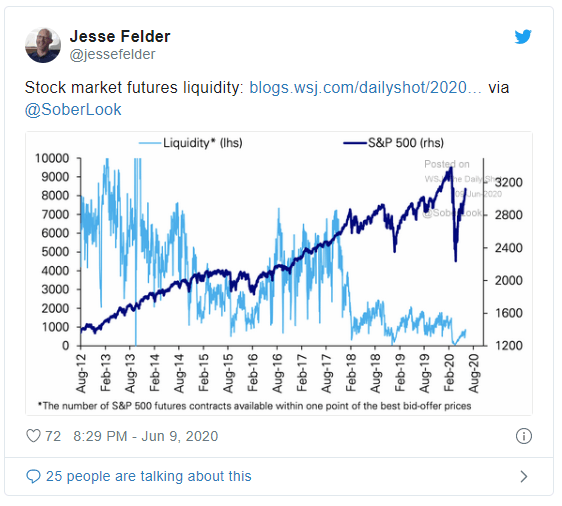
Combine massive money printing with mass speculation and record low liquidity (in futures and almost every other market) and you get the fastest 50-day rise in the stock market on record.


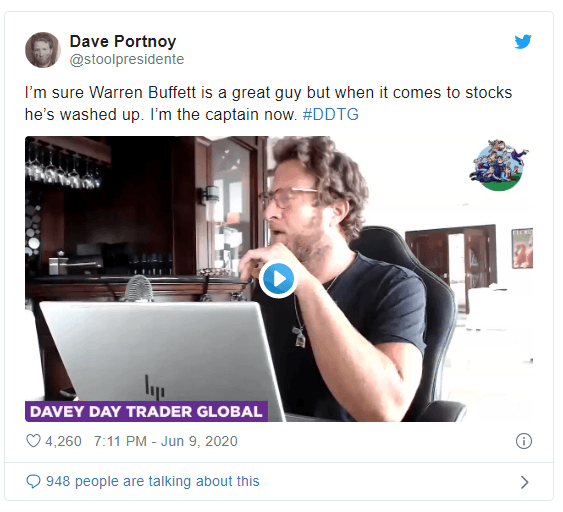
As a result, we now have an army of traders who believe they are the second coming of Warren Buffett. While the Oracle of Omaha now looks foolish for selling his airline stocks, those who bought them up over the past few months are gloating like you rarely see in this game.


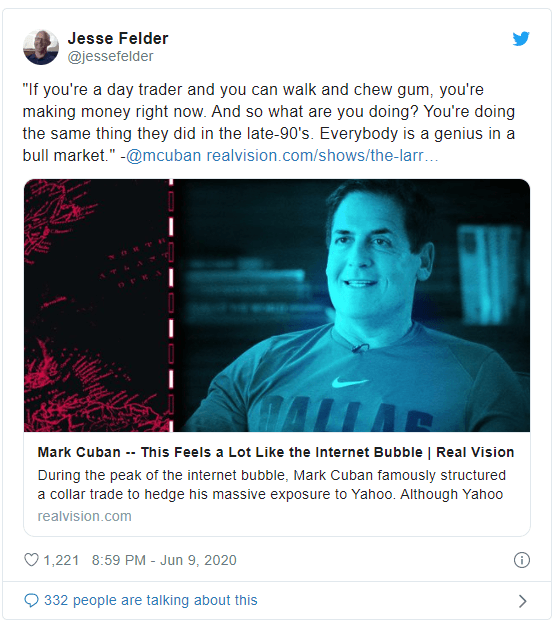
Like Mark Cuban said, "everybody is a genius in a bull market," and the largest 50-day gain in history is minting a ton of geniuses right now.


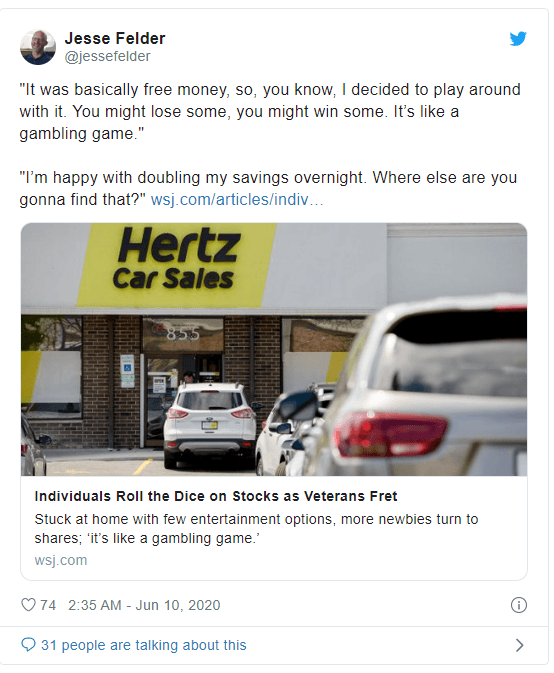
To get a sense of the mindset of many of these traders, the Wall Street Journal spoke to a few of them and they make no bones about gambling with the funds the government sent them as part of the CARES Act, trying to double or triple it in just a day's time.


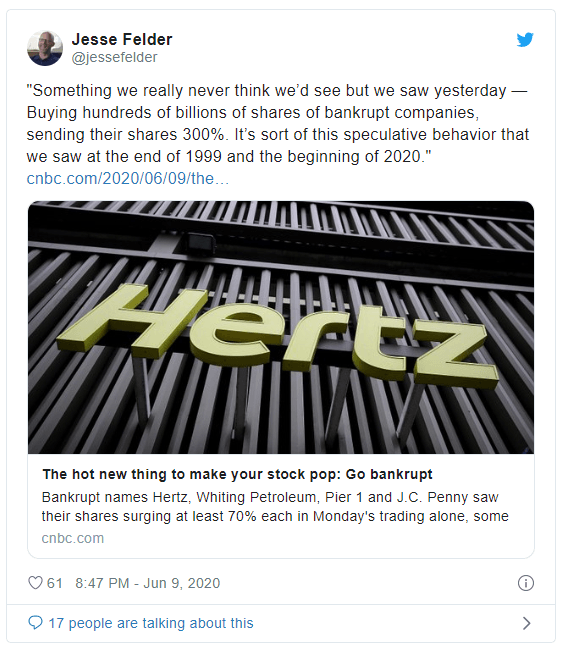
In 1999 and 2000, day traders went for the hottest internet stocks of the day in trying to make outsized returns; eventually many went bankrupt. Today, they're looking for outsized returns in the stocks that have already filed for bankruptcy protection!


But if there's a lesson from that earlier period, it's this:


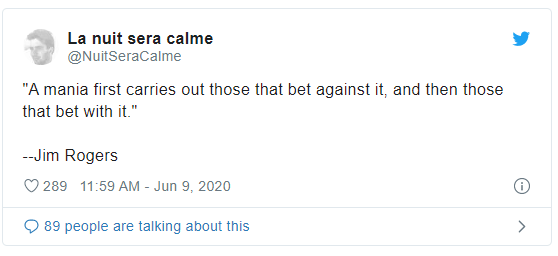
This rally has humbled not only Warren Buffett but also Stan Druckenmiller, Sam Zell, Carl Icahn, Paul Singer, Jim Rogers and a host of other true geniuses of the industry whom have bet against it. It seems like it may soon be time for it to carry out those betting with it.

- Source, Seeking Alpha

Tuesday, May 26, 2020

Jim Rogers: Petrol is Not Going to Stay Dirt Cheap for Five Years, Opportunities Exist

"They have to look at the same factors – supply and demand. If we look at energy, for instance, known reserves of oil have been declining for years. And then along came fracking. Fracking was a miracle, but fracking turned into a bubble. If you could spell fracking, people would give you money to invest. Now, fracking is not going to disappear. It’s going to disappear for a lot of people because some are going bankrupt. But fracking is still going to be around, but it’s not a bubble anymore. And they have to worry about supply and demand like everybody else.

Sugar is down something like 75% or 80% percent from its all-time high. I don’t know many things that are down 75% or 80% percent from their all-time high. So all commodities dealers, producers and consumers are going to have to worry now about supply and demand. Most consumers are going to be better off if you are asking about the next year or two, except [those exposed to] gold. So most people are getting a benefit from this collapse, at least in their cost of living, if they have a job.

But now we all have to start worrying, including producers and consumers, about supply and demand because the price of most commodities are not going to stay down here where they are. I don’t think petrol is going to stay dirt cheap for the next five years, because production is starting to decline. So the answer is simple – supply and demand."

- Source, SPGlobal