Saturday, February 22, 2020

China’s long-term improving trend for the economy will not change

The improving trend will be maintained and supported by measures that have been taken since the novel coronavirus outbreak as well as the resilience of the Chinese economy itself.

The government has introduced a series of measures to counter the negative impact caused the outbreak. As of Thursday, governments at all levels had allocated 66.74 billion yuan (about 9.55 billion U.S. dollars) for the containment of the epidemic. Over 40 percent of the allocation has already been spent. The central bank has provided re-lending funds of 300 billion yuan (up to 43 billion U.S. dollars) to national banks and local banks in the worst-hit regions, which will then grant credit support at favorable interest rates to key manufacturers of medical supplies and daily necessities.

Earlier this week, the central bank pumped a total of 1.7 trillion yuan (243 billion U.S. dollars) of liquidity to stabilize the financial markets, after which the stock market rebounded and cross-border capital flows and foreign exchange supply and demand remained basically stable. The latest performance of the financial markets reflects investor confidence in the Chinese government’s ability to contain the epidemic and in the country’s future economic growth.

China’s economic fundamentals have set a solid foundation for long-term growth. The outbreak has so far affected such sectors as tourism, catering and entertainment, especially as it hit the nation during the annual Spring Festival holiday. But the impact is expected to be temporary. During this period, such areas as online shopping, online health services and online gaming have seen rapid growth, which may make up for some losses in the tertiary sector. Moreover, the resilient Chinese economy will see compensatory recovery in investment and consumption after the epidemic is over, which according to Jim O’Neill, Chair of Britain’s Chatham House, may be realized in the second quarter of the year.

More importantly, China’s comprehensive supply chain also provides solid foundation for post-epidemic economic catch-up. Unlike U.S. Commerce Secretary Wilbur Ross who thought the outbreak in China would help to accelerate the return of jobs to North America, renowned international investor, Jim Rogers, has said he believes the epidemic is not going to cause anybody to leave China and go back to America or anywhere else. He noted that companies had not left America because 80,000 people died of flu in the United States last year.

As China has plenty of policy tools and ample room for maneuver, it’s able to keep up the trend of the Chinese economy growing steadily in a long term. That’s why the World Bank and the International Monetary Fund have both expressed their confidence in China’s economic outlook this year.

- Source, CGTN

Wednesday, February 19, 2020

How much impact will the coronavirus outbreak have on China's economy?

In addition to taking hundreds of lives, the novel coronavirus outbreak in China has also cast a shadow over economic growth prospects.

Einar Tangen, independent current affairs commentator, said that this epidemic is not going to be as big an issue as many people are showing, and it's not going to have a huge impact on the Chinese economy. The markets are showing a lot of panic, but it's probably wrong, for the government is acting very aggressively to curtail this particular virus, and they're going to shorten it. Hopefully this will only last three months, which means just one quarter, and there will be a lot of catch-up through the rest of the year.

At the same time, he also emphasized that the government has to act quickly to make sure that companies, especially small and medium-size enterprises, don't go under during this process.

Jim Rogers, international investor and author of "A Warning to Japan," added that the Chinese government has to cut losses as quickly as possible.

The novel coronavirus outbreak will only have a temporary impact on China's economy, and the country's good economic fundamentals for long-term growth remain unchanged, said the National Development and Reform Commission.

However, Hong Hao, chief strategist of the Bank of Communications International, considered the impact of the coronavirus on Chinese economy flitting, if the forecast that the peak of this virus is within the month of February turns out to be true. Nevertheless, the first quarter would be a tough time for the Chinese economy.

He also pointed out that the internet industry and healthcare industry would get potential development opportunities from this coronavirus outbreak.

The World Health Organization (WHO) said it wasn't in favor of imposing travel or trade restrictions on China, but countries such as the U.S. and Australia have imposed a China travel ban.

Tangen believed that there's no need to impose a travel ban on China, and what those countries did is "overreaction." WHO made it pretty clear that China needs to take aggressive actions, but it's not necessary elsewhere.

Rogers revealed that unfortunately, politicians and bureaucrats love things like the travel ban, because then they can tell their people that they're solving problems, but actually they're usually making problems worse.

United States Commerce Secretary Wilbur Ross considered the coronavirus outbreak as a boost to the U.S. economy, because, as he said, "it will help to accelerate the return of jobs to North America".

Rogers expressed his surprise at this kind of remark. He further pointed out that this epidemic is not going to cause anybody to leave China and go back to America or anywhere else. Rogers noted companies did not leave America because 8,000 people died of flu in the U.S. last year.

- Source, CGTN

Sunday, February 16, 2020

Budget 2020 needs to open the economy and make India dynamic

"Investment guru Jim Rogers said that unlike previous budgets', this time the NDA govt should focus on opening the economy in its budget presentation and make India a dynamic economy. 

Union Budget 2020 will be finance minister Nirmala Sitharaman’s second full Union Budget. A huge pressure will be on the NDA govt and FM Sitharaman as India is facing its worst economic slowdown in a decade. 

The economic growth this year will slip to 5% as per govt estimation."

- Source, Times of India

Friday, February 14, 2020

Dollar surge threatens even modest energy recovery

Legendary investor Jim Rogers observed that commodity markets have to fall below the cost of production to finally make a bottom. This wipes out the bull market excesses off those who borrowed too much money. Their debt load forces them out of the game, bankruptcy or merger, as the “strong hands” take over.

This column has warned that low LNG prices might/would threaten the billion dollar LNG export terminals being constructed in Corpus Christi and elsewhere along the Gulf Coast. Sure enough, Cheniere symbol LNG (how is that for irony?) dropped 3.4 percent Thursday to a new recent low of $57.65. Debt-ridden Chesapeake CHK is trading at 54 cents.

The entire energy complex (crude, heat, gasoline, natgas) registered lows this past Tuesday. Taking those lows out will suggest any hope of a mild temporary recovery has been erased, which we suggested last week. The low Tuesday for natural gas was $1.80. Overproduction and lack of transport to markets has overwhelmed demand and price continues to fall.

As we have so often observed, to make matters worse, the U.S. dollar has surged to a new high. Asian contagion flu has investors running away from all things China and embracing the U.S. dollar, up 1.2 percent Thursday. The last high was 99 on the dollar index. I expect that be taken out this next week. Commodities like gold, silver, and energy are priced in U.S. dollars. A stronger dollar means commodity prices fall and still maintain their relative values.

Even if crude manages a short-term rally from its oversold condition here at $50.95, the wave patterns suggest lower prices over the next month. As posted last week, if the $50 level falls, $40 looks likely.

Narrowing breadth is a feature of a topping stock market. Just five stocks, MSFT, AAPL, FB, GOOGL, and AMZN account for 18 percent of the S&P 500. And it is their continued rise and weighting that is powering the averages to new highs. This reminds one of the top in 2000 when dot.coms, GE, and MSFT dominated. Speaking of which, TESLA is now worth well more than the big three automakers in the U.S. $55 billion of TESLA was traded on Tuesday more than the next ten most traded stocks including several of the FANGS.

TESLA is now valued at 183 times its $4.10 earnings. This looks awfully frothy to me, especially as social mood deteriorates further at the end of the State of the Union message.

- Source, In the Pipeline

Friday, February 7, 2020

Jim Rogers: Geopolitical Tension

The geopolitical tension hanging over the US stock market can’t be overlooked in 2020. The most obvious disruptor is the conflict with Iran, despite the fact that investors had largely shrugged it off by the end of last week.

This weekend Iran took responsibility for shooting down a Ukrainian passenger plane, a development that will surely escalate the conflict within the region. This kind of incremental rise in tension is likely just the beginning. At some point, investors may start to get nervous resulting in a mass-exodus.

The other issue at hand is the trade war with China, which has been put on the back burner in light of the Iran conflict. But investors shouldn’t forget that the trade issues between the US and China are still unresolved, meaning there’s potential for two sides to reverse course in the year ahead. As Jim Rogers pointed out,

Historically, trade wars have always been a disaster. No one has ever won a trade war. Trade wars frequently, or often, have led to real wars. It makes sense, you start slapping someone in the face and you slap them again and you slap them again [they’re going to fight back]. I mean they have to.

With both of those major catalysts still hanging over the market, investors are likely to react erratically to perceived bad news. That could be dangerous in a market where everyone is looking for an excuse to take profits.

- Source, CCN

Tuesday, February 4, 2020

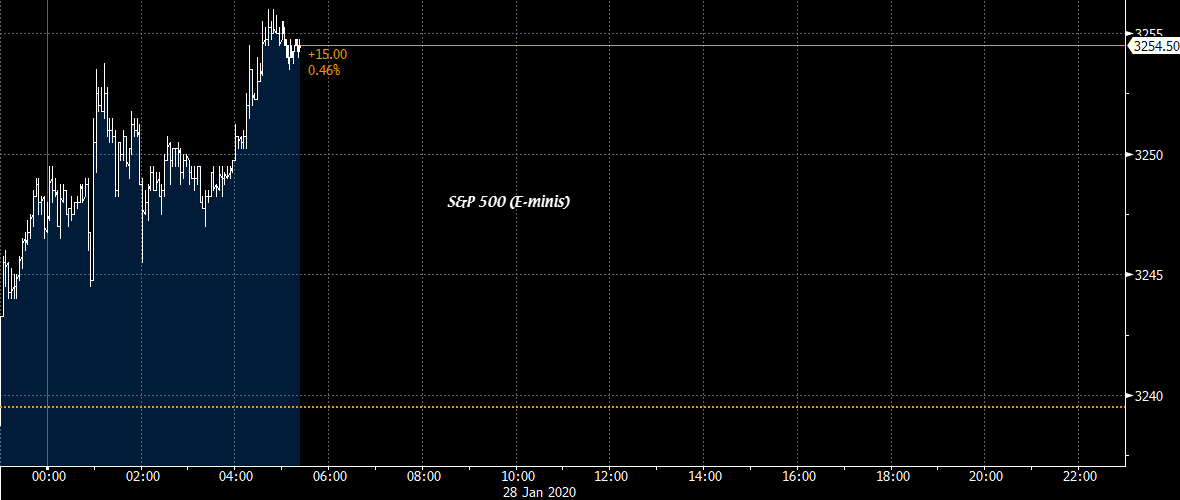
US Futures Largely Shrugging Of Virus Concerns So Far

After a downbeat day in trading yesterday, US equity futures are pointing to a better Tuesday so far as we looks towards European morning trade.

Markets are starting to take the coronavirus headlines in stride and this piece of Apple news earlier certainly adds to more positivity on the day.

As the situation surrounding the coronavirus outbreak continues to grip markets, the thing to watch out for is when fear starts to get overblown i.e. mass panic and hysteria.

Fear is bad for risk but when it evolves into hysteria, that's when things have gone too far.


We haven't quite steered clear of the coronavirus ship just yet (remember, it took markets about ~5 months to get over the SARS virus) and that means there could be more rocky days still to come as the situation develops.

But unless this threatens to blow out humanity or significantly alter the landscape of global travel in big picture, it's important to keep a calm head about you and put things into perspective over the next six months to a year.

Jim Rogers' quote of "buying value, and selling hysteria" is one I always stick with when viewing situations like this. It may still be early days now in evaluating the coronavirus situation, but it is never too early to keep that in the back of your mind.

- Source, Forex Live

Monday, February 3, 2020

Investment Guru Jim Rogers on Budget 2020, says India is only increasing debts


Investment Guru Jim Rogers on his expectations from India's Budget 2020, says 'PM Modi always says that he is going to balance the budget but he never does it. India is only increasing debts every year'.

- Source, Times Now

Sunday, February 2, 2020

Three Alarming Indicators Point to a Stock Market Crash


Warnings that a US stock market crash is on the horizon are in no shortage. Despite that, the Dow Jones and S&P 500 continued to march higher at the start of 2020. 

While investors have so-far turned their noses up at warnings about inflated valuations, geopolitical instability, and ballooning debt, the facts about the precarious state of the US stock market can’t be ignored. 

With that in mind, 2020’s gains have made the chances of a stock market crash even more likely as irrational, fearless investing has taken over.

- Source, CCN

Wednesday, January 29, 2020

Jim Rogers: A Global Debt Crisis is On the Horizon

Jim Rogers believes that the next bear market will be the worst he’s ever seen. Sky-high debt, he says, is the reason for his pessimism.

In 2008 we had a problem because of too much debt. Since then the debt everywhere in the world has skyrocketed. The Federal Reserve, the central bank in the US increased its balance sheet by 500% in 10 years. That alone is an unbelievable statement.

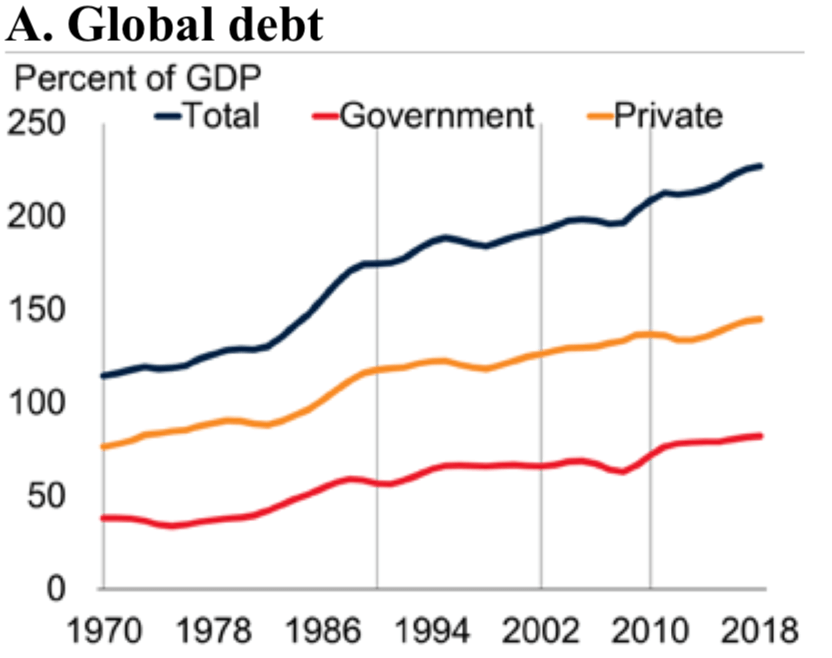
He’s not alone in his worries about global debt. In it’s bi-annual Global Economic Prospects, the World Bank warned that a global debt crisis could be on the horizon as borrowing has risen to its highest level in the past 50 years. The bank warned that although debt has become more manageable due to low interest rates, a fresh financial crisis isn’t out of the question. The risk is especially prevalent among emerging and developing economies, where total debt reached nearly 170% of GDP in 2018. 

Source: World Bank

Debt across the globe has also been building to worrying levels, though. According to the World Bank report:

Since the global financial crisis, another wave has been building, with both global debt and debt in EMDEs reaching all-time highs. The latest wave has also seen the largest, fastest and most broad-based increase in debt in EMDEs. Historically, episodes of rapid debt accumulation have often been associated with financial crises.

- Source, CCN

Saturday, January 25, 2020

Jim Rogers: This is Insanity, Horrible Times Lay Ahead

The Fed has increased its balance sheet over 500% in the past decade; The Bank of Japan is printing money to buy bonds and stock ETFs; and The European Central Bank is mired in insane negative interests. And, according to legendary investor Jim Rogers, they will continue this “madness” as long as its necessary.

In an interview with RT’s Boom Bust, Rogers exclaims, that interest rates around the world have never been this low:

“… this is insanity, that’s not how sound economic systems are supposed to work.”

In 2008, Rogers notes that we had problems because of too much debt, however, “since then the debt has skyrocketed everywhere and it’s going higher and higher. We are going to have a horrible time when this all comes to an end.”

Adding that:

…eventually, the market is going to say: ‘We don’t want this, we don’t want to play this game anymore, and we don’t want your garbage paper anymore’.”

And when that happens, Rogers warns that central banks will print even more and buy even more assets.

“And that’s when we will have very serious problems… We all are going to pay a horrible price someday but in the meantime it’s a lot of fun for a lot of people.”

When it comes to an end, Rogers laments, “it will be the worst of my lifetime.”

- Source, Lew Rockwell