Wednesday, February 12, 2020
Monday, February 10, 2020
Friday, February 7, 2020
Jim Rogers: Geopolitical Tension
The geopolitical tension hanging over the US stock market can’t be overlooked in 2020. The most obvious disruptor is the conflict with Iran, despite the fact that investors had largely shrugged it off by the end of last week.
This weekend Iran took responsibility for shooting down a Ukrainian passenger plane, a development that will surely escalate the conflict within the region. This kind of incremental rise in tension is likely just the beginning. At some point, investors may start to get nervous resulting in a mass-exodus.
The other issue at hand is the trade war with China, which has been put on the back burner in light of the Iran conflict. But investors shouldn’t forget that the trade issues between the US and China are still unresolved, meaning there’s potential for two sides to reverse course in the year ahead. As Jim Rogers pointed out,
Historically, trade wars have always been a disaster. No one has ever won a trade war. Trade wars frequently, or often, have led to real wars. It makes sense, you start slapping someone in the face and you slap them again and you slap them again [they’re going to fight back]. I mean they have to.
With both of those major catalysts still hanging over the market, investors are likely to react erratically to perceived bad news. That could be dangerous in a market where everyone is looking for an excuse to take profits.
- Source, CCN

Tuesday, February 4, 2020
US Futures Largely Shrugging Of Virus Concerns So Far
After a downbeat day in trading yesterday, US equity futures are pointing to a better Tuesday so far as we looks towards European morning trade.
Markets are starting to take the coronavirus headlines in stride and this piece of Apple news earlier certainly adds to more positivity on the day.
As the situation surrounding the coronavirus outbreak continues to grip markets, the thing to watch out for is when fear starts to get overblown i.e. mass panic and hysteria.
Fear is bad for risk but when it evolves into hysteria, that's when things have gone too far.
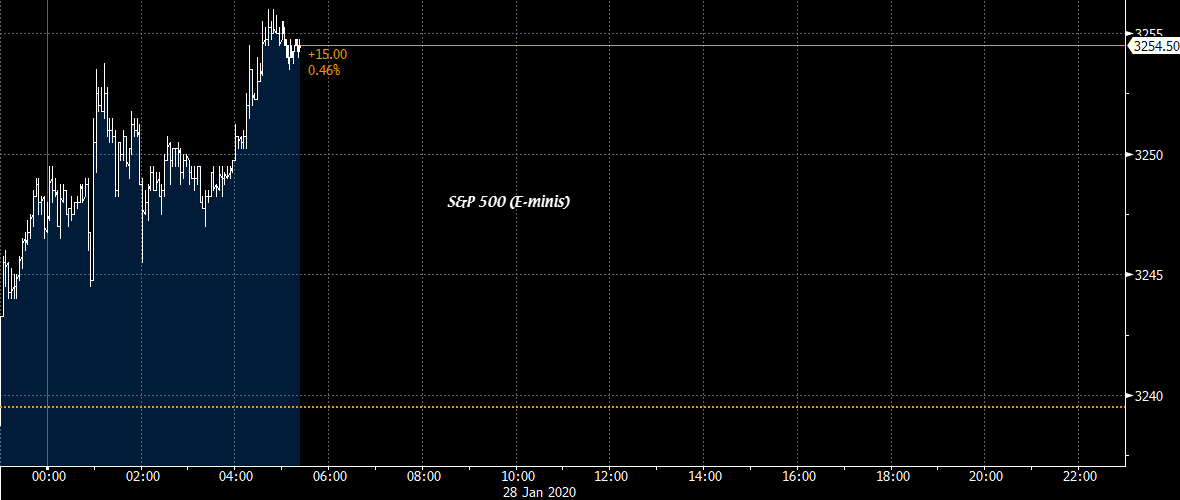
We haven't quite steered clear of the coronavirus ship just yet (remember, it took markets about ~5 months to get over the SARS virus) and that means there could be more rocky days still to come as the situation develops.
But unless this threatens to blow out humanity or significantly alter the landscape of global travel in big picture, it's important to keep a calm head about you and put things into perspective over the next six months to a year.
Jim Rogers' quote of "buying value, and selling hysteria" is one I always stick with when viewing situations like this. It may still be early days now in evaluating the coronavirus situation, but it is never too early to keep that in the back of your mind.
Markets are starting to take the coronavirus headlines in stride and this piece of Apple news earlier certainly adds to more positivity on the day.
As the situation surrounding the coronavirus outbreak continues to grip markets, the thing to watch out for is when fear starts to get overblown i.e. mass panic and hysteria.
Fear is bad for risk but when it evolves into hysteria, that's when things have gone too far.
We haven't quite steered clear of the coronavirus ship just yet (remember, it took markets about ~5 months to get over the SARS virus) and that means there could be more rocky days still to come as the situation develops.
But unless this threatens to blow out humanity or significantly alter the landscape of global travel in big picture, it's important to keep a calm head about you and put things into perspective over the next six months to a year.
Jim Rogers' quote of "buying value, and selling hysteria" is one I always stick with when viewing situations like this. It may still be early days now in evaluating the coronavirus situation, but it is never too early to keep that in the back of your mind.
- Source, Forex Live
Monday, February 3, 2020
Investment Guru Jim Rogers on Budget 2020, says India is only increasing debts
- Source, Times Now
Sunday, February 2, 2020
Three Alarming Indicators Point to a Stock Market Crash
While investors have so-far turned their noses up at warnings about inflated valuations, geopolitical instability, and ballooning debt, the facts about the precarious state of the US stock market can’t be ignored.
With that in mind, 2020’s gains have made the chances of a stock market crash even more likely as irrational, fearless investing has taken over.
- Source, CCN
Wednesday, January 29, 2020
Jim Rogers: A Global Debt Crisis is On the Horizon
Jim Rogers believes that the next bear market will be the worst he’s ever seen. Sky-high debt, he says, is the reason for his pessimism.
In 2008 we had a problem because of too much debt. Since then the debt everywhere in the world has skyrocketed. The Federal Reserve, the central bank in the US increased its balance sheet by 500% in 10 years. That alone is an unbelievable statement.
He’s not alone in his worries about global debt. In it’s bi-annual Global Economic Prospects, the World Bank warned that a global debt crisis could be on the horizon as borrowing has risen to its highest level in the past 50 years. The bank warned that although debt has become more manageable due to low interest rates, a fresh financial crisis isn’t out of the question. The risk is especially prevalent among emerging and developing economies, where total debt reached nearly 170% of GDP in 2018.
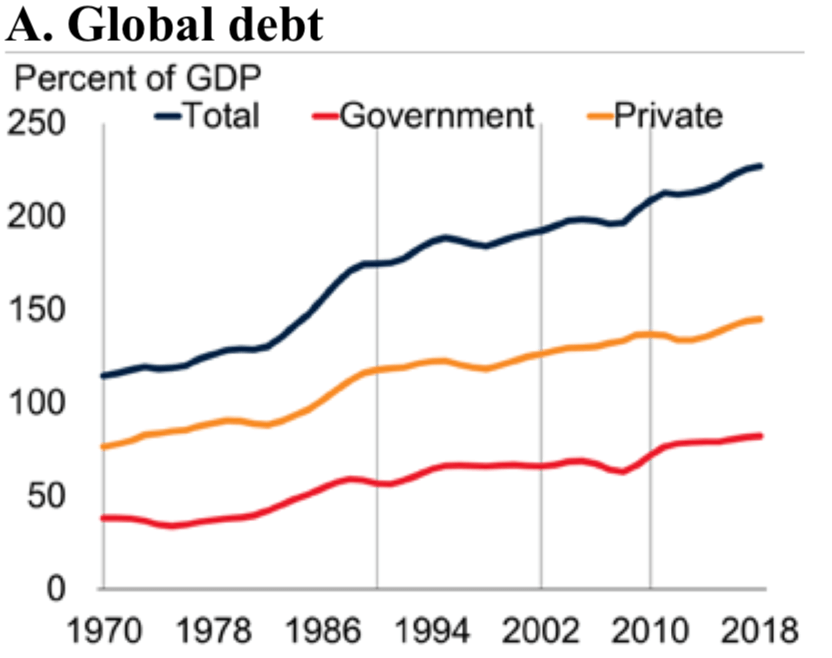 Source: World Bank
Debt across the globe has also been building to worrying levels, though. According to the World Bank report:
Since the global financial crisis, another wave has been building, with both global debt and debt in EMDEs reaching all-time highs. The latest wave has also seen the largest, fastest and most broad-based increase in debt in EMDEs. Historically, episodes of rapid debt accumulation have often been associated with financial crises.
In 2008 we had a problem because of too much debt. Since then the debt everywhere in the world has skyrocketed. The Federal Reserve, the central bank in the US increased its balance sheet by 500% in 10 years. That alone is an unbelievable statement.
He’s not alone in his worries about global debt. In it’s bi-annual Global Economic Prospects, the World Bank warned that a global debt crisis could be on the horizon as borrowing has risen to its highest level in the past 50 years. The bank warned that although debt has become more manageable due to low interest rates, a fresh financial crisis isn’t out of the question. The risk is especially prevalent among emerging and developing economies, where total debt reached nearly 170% of GDP in 2018.
Source: World BankDebt across the globe has also been building to worrying levels, though. According to the World Bank report:
Since the global financial crisis, another wave has been building, with both global debt and debt in EMDEs reaching all-time highs. The latest wave has also seen the largest, fastest and most broad-based increase in debt in EMDEs. Historically, episodes of rapid debt accumulation have often been associated with financial crises.
- Source, CCN
Saturday, January 25, 2020
Jim Rogers: This is Insanity, Horrible Times Lay Ahead
The Fed has increased its balance sheet over 500% in the past decade; The Bank of Japan is printing money to buy bonds and stock ETFs; and The European Central Bank is mired in insane negative interests. And, according to legendary investor Jim Rogers, they will continue this “madness” as long as its necessary.
In an interview with RT’s Boom Bust, Rogers exclaims, that interest rates around the world have never been this low:
“… this is insanity, that’s not how sound economic systems are supposed to work.”
In 2008, Rogers notes that we had problems because of too much debt, however, “since then the debt has skyrocketed everywhere and it’s going higher and higher. We are going to have a horrible time when this all comes to an end.”
Adding that:
…eventually, the market is going to say: ‘We don’t want this, we don’t want to play this game anymore, and we don’t want your garbage paper anymore’.”
And when that happens, Rogers warns that central banks will print even more and buy even more assets.
“And that’s when we will have very serious problems… We all are going to pay a horrible price someday but in the meantime it’s a lot of fun for a lot of people.”
When it comes to an end, Rogers laments, “it will be the worst of my lifetime.”
- Source, Lew Rockwell
Thursday, January 23, 2020
CHAIN 2020 Conference Gathers Almost 14,000 People
The event was held at the AsiaWorld-Expo in Check Lap Kok, Hong Kong, and had the goal of informing attendees of the power of blockchain and how they can use it to advance technology.
Organized by one of the currently largest crypto exchanges by volume, Coinsbit, the blockchain educational conference in Hong Kong drew the attention of almost 14,000 people on January 15, Coinsbit announced today.
The reported numbers would make this event one of the largest in the blockchain sector. Wall Street legend Jim Rogers and Ethereum Foundation team member Vlad Zamfir opened the conference with an interesting discussion on technology, trading, and investing.
One of the more popular attractions at the event was Sophia, the human-like robot created by Hanson Robotics. Known as the most advanced humanoid AI, people flocked around Sophia to interact with her on different subjects.
Natalia Simson, Coinsbit development director, spoke at the conference, conveying a strong message about the importance of stablecoins and their role in cooperating with cryptocurrency exchanges.
Other prominent names in the industry also attended the conference, including Susan Oh, recipient of The Quantum Impact Award, Dinis Guarda, a prominent author, academic, and entrepreneur, and Susanne Tarkowski Tempelhof, an award-winning entrepreneur.
The goal of the conference was to popularize blockchain technology in the Asia region, informing attendees of the possibilities of using blockchain to advance technology in general. The event was held at the AsiaWorld-Expo located in Chek Lap Kok, Hong Kong.
- Source, Chain Bulletin
Monday, January 20, 2020
Jim Rogers: What 2020 has in Store for Global Markets
RT Correspondent John Huddy is digs into the latest developments in the situation. Plus, we are back on the ground in Las Vegas, where 2020's Consumer Electronics Show has entered its third day. RT's Brent Jabbour is there and will bring us up to speed on the latest developments in the auto sector.
- Source, Jim Rogers Blog
Thursday, January 16, 2020
Jim Rogers Exclusive: The Governments Have The Guns
- Source, Big Eye
Saturday, January 4, 2020
Jim Rogers Calls Kim’s Bluff: North Korea Needs Foreign Investment
Rogers Holdings CEO Jim Rogers says there are still chances for outsiders to make money in North Korea because the country’s leader, Kim Jong Un , desperately needs foreign investment despite a recent order to demolish all South Korean facilities at the Mount Kumgang resort.
“In 2008, we had a recession because of too much debt, and now the debt is much higher everywhere. Even China, which in 2008 had a lot of money saved for a rainy day, has debt now.”
In 2018, Rogers was appointed the outside director ofAnanti , a South Korean company that built and managed a golf course at the Kumgang resort.
“I’ve never met the man so I don’t know what he thinks, but I speculated that maybe, what he was doing was part of a negotiation ploy,” Rogers said, according to The Korea Herald.
Rogers thinks Kim is trying new negotiating tactics — such as demolishing the resort that was built with cooperation between North and South Korea.
“If you tell somebody you’re going to do bad things, then they come and start to negotiate,” Rogers said. “I would suspect that he is trying to get better deals because he needs foreign investment very, very much.”
Rogers also thinks Kim’s decision to remove the South Korean facilities would scare away other foreign investors, and he eventually “wants a peace regime.”
“He wants to open North Korea, rebuild its economy and has said that he wants to dofor North Korea what Deng Xiaoping did for China,” Rogers said.
And if investment in North Korea was allowed by U.S.citizens , Rogers would probably be first in line because he sees a big opportunity in tourism.
“Tourism is an obvious investment opportunity because the country has never been on the world tourism map,” Rogers said. “Once the North opens up, many people will want to go and see its beaches, mountains, temples and other man-made sites.”
As far as the rest of the world markets go, Rogers kept up his prediction that the worst economic downturn of his lifetime is coming.
“In 2008, we had a recession because of too much debt, and now the debt is much higher everywhere,” Rogers said. “Even China, which in 2008 had a lot of money saved for a rainy day, has debt now. So the next time we have a problem, it’s going to be terrible.”
“In 2008, we had a recession because of too much debt, and now the debt is much higher everywhere. Even China, which in 2008 had a lot of money saved for a rainy day, has debt now.”
In 2018, Rogers was appointed the outside director of
“I’ve never met the man so I don’t know what he thinks, but I speculated that maybe, what he was doing was part of a negotiation ploy,” Rogers said, according to The Korea Herald.
Rogers thinks Kim is trying new negotiating tactics — such as demolishing the resort that was built with cooperation between North and South Korea.
“If you tell somebody you’re going to do bad things, then they come and start to negotiate,” Rogers said. “I would suspect that he is trying to get better deals because he needs foreign investment very, very much.”
Rogers also thinks Kim’s decision to remove the South Korean facilities would scare away other foreign investors, and he eventually “wants a peace regime.”
“He wants to open North Korea, rebuild its economy and has said that he wants to do
And if investment in North Korea was allowed by U.S.
“Tourism is an obvious investment opportunity because the country has never been on the world tourism map,” Rogers said. “Once the North opens up, many people will want to go and see its beaches, mountains, temples and other man-made sites.”
As far as the rest of the world markets go, Rogers kept up his prediction that the worst economic downturn of his lifetime is coming.
“In 2008, we had a recession because of too much debt, and now the debt is much higher everywhere,” Rogers said. “Even China, which in 2008 had a lot of money saved for a rainy day, has debt now. So the next time we have a problem, it’s going to be terrible.”
- Source, Money and Markets
Subscribe to:
Posts (Atom)